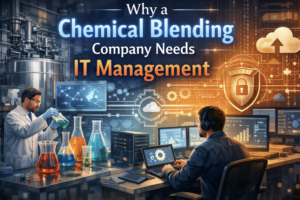
Chemical blending is a business built on exactness. Formulas, tolerances, batch sequencing, labeling, storage conditions, shipping documentation, and customer specifications all have to line up the same way every time. That kind of consistency is not only a production goal, it is a reputation requirement. Strong IT Management turns that expectation into something repeatable, measurable, and protected across the entire operation. ⚙️
Modern blending facilities depend on connected systems that touch everything from production scheduling to quality assurance to inventory traceability. When those systems are managed proactively, the plant runs smoother, data stays trustworthy, compliance work becomes cleaner, and customer confidence rises. When those systems are managed reactively, downtime stretches, errors multiply, and risk creeps into places that are hard to see until it is expensive.
Chemical blending is an information business disguised as manufacturing 🧾
A blending operation generates and relies on constant flows of information: formulations, batch tickets, lot numbers, SDS access, QC test results, calibration records, training logs, maintenance documentation, shipping manifests, and customer certificates. The value is not only in the physical product but also in the accuracy of the data trail that proves what the product is, how it was made, and where it went.
IT Management keeps that data trail reliable by designing how information is captured, where it is stored, who can change it, and how it is recovered if something breaks. That includes practical controls like permissions, change tracking, system backups, and standardized workflows that reduce the chance of “shadow processes” living on someone’s laptop. 🧠
Clear thinking about IT management also aligns with the broader discipline described in Information technology management, where technology resources are managed around business priorities rather than treated as a pile of tools.
Batch integrity depends on stable systems and disciplined access controls 🔒
Blending facilities often run a mix of systems: ERP, inventory and warehousing, production scheduling, labeling software, QA/QC tools, maintenance platforms, and sometimes manufacturing execution or historian data. The risk is not only “a system goes down.” The deeper risk is “a system stays up but the wrong data gets in.” Incorrect lot assignment, mislabeled packaging, outdated formulations, or an uncontrolled spreadsheet can create costly rework and customer issues.
IT Management reduces these risks by enforcing:
-
Role-based access so only the right people can edit formulas, specs, and master data
-
Controlled change management so updates are logged and validated
-
Versioning of critical documents and digital batch records
-
Clean integrations between systems so the same truth flows everywhere
When access and changes are handled consistently, the plant does not rely on luck or memory. It relies on structure. ✅
Downtime hits blending operations harder than most teams realize ⛔
In chemical blending, downtime rarely stops at one workstation. It can disrupt weigh-up stations, label printing, shipping, receiving, QA sampling, and production reporting all at once. The cost is not only lost hours. It is missed ship dates, rushed changeovers, and increased chances of mistakes when teams are forced into manual workarounds.
IT Management creates resilience through:
-
Redundant systems for critical operations
-
Business continuity planning for “when, not if” disruptions happen
-
Backup strategies that are tested, not assumed
-
Patch and lifecycle planning so aging servers and unsupported software do not become single points of failure
Many technology incidents that begin as “small IT issues” become operational incidents quickly. Staying close to credible, ongoing coverage in IT news helps leaders stay alert to emerging risks and patterns, including the real-world impact of outages and cyber events reported by Reuters Technology. 📰
Cybersecurity is now operational safety for industrial businesses 🛡️
Blending companies increasingly depend on connected devices, remote access, cloud platforms, vendor portals, and sometimes OT-adjacent systems in production environments. That connectivity improves efficiency, but it also increases the attack surface. A cyber incident can lock up production systems, expose customer data, interrupt shipping, or compromise the integrity of batch documentation.
IT Management reduces cybersecurity exposure by making security operational, not theoretical:
-
Asset inventories that include servers, endpoints, and critical applications
-
Security monitoring and alerting with clear escalation paths
-
Segmentation between business networks and sensitive systems
-
Strong identity controls and multi-factor authentication
-
Vendor access governance and auditing
Staying tuned to cybersecurity developments also matters because threats evolve quickly, and the practical lessons often show up first in trusted reporting like Reuters Cybersecurity and ongoing coverage from outlets focused on real incidents and trends such as WIRED Security. 🚨
Compliance and customer audits get easier when IT is managed on purpose 📋
Customers and regulators expect traceability, documentation, and confidence that your records reflect what happened. IT Management supports audit readiness by ensuring:
-
Systems maintain data integrity and time-stamped records
-
Documents are stored with proper access control and retention
-
Electronic records are backed up and recoverable
-
Training systems and SOPs are standardized and accessible
-
Quality and production systems can produce clean reports without last-minute scrambling
This is not about creating paperwork. It is about making sure the business can prove it does what it says it does, consistently.
Quality control gets faster and more reliable with the right IT foundation 🧪
QA/QC teams thrive on clean data. Test results, nonconformance reports, corrective actions, and trend analysis all become more valuable when systems are stable and integrated. Good IT Management helps QC avoid the common traps: duplicate data entry, inconsistent naming conventions, disconnected tools, and “mystery files” with unclear ownership.
When IT is managed well, QC gains:
-
Faster retrieval of historical lot and batch details
-
Better trend visibility for process improvement
-
Cleaner handoffs between production and quality
-
Reduced risk of transcription errors from manual re-entry
That tight loop between production and quality improves both customer outcomes and internal efficiency. 📈
Supply chain and inventory accuracy depend on dependable integrations 🚚
A blending company is only as smooth as its materials flow. Raw materials, packaging components, and finished goods must be tracked accurately across receiving, storage, staging, production, and shipping. Poor integrations between purchasing, inventory, production reporting, and labeling can lead to shortages, overstocks, mis-picks, and shipping errors.
IT Management helps unify the system so the business runs from one set of numbers. It also reduces the “spreadsheet sprawl” that tends to grow when teams cannot trust the core systems. For leaders watching where enterprise tech is going next, reputable industry coverage like The Verge Tech can be a practical way to track shifts in platforms, automation, and security expectations that increasingly influence B2B operations. 🧩
Modern IT management supports automation without chaos 🤖
Automation is not only robots and conveyors. In many blending businesses, automation starts with simpler wins: standardized labeling workflows, automated document generation, barcode scanning, integrated QC data entry, scheduled reporting, and alerts that prevent small issues from becoming big ones.
Those improvements only work when the IT environment is stable, secure, and well-governed. Otherwise, automation becomes a patchwork of one-off fixes that only one person understands. IT Management turns automation into a long-term capability by creating standards, documentation, and ownership that outlasts any single employee. 🧱
For an ongoing read on how technologists think about systems, reliability, and security in practice, sources like Ars Technica Security often highlight the real-world consequences of vulnerabilities and the operational discipline required to reduce them.
IT Management improves leadership visibility and decision-making 🧭
Plant managers and owners need clarity: what is selling, what is late, what is being reworked, what materials are tight, what customers are trending up or down, and where quality issues are clustering. Those answers come from systems that produce consistent, trustworthy reporting.
IT Management improves that visibility by:
-
Defining master data standards so reports match reality
-
Reducing manual steps that introduce errors
-
Ensuring uptime and performance of reporting tools
-
Establishing dashboards that reflect operational priorities
This is not “more data.” It is better signal, delivered reliably. 📊
Conclusion: IT Management protects consistency, profitability, and trust ✅
Chemical blending companies win by being dependable. Customers stay when batches are right, documentation is clean, ship dates are met, and communication is confident. IT Management is the backbone that makes that consistency scalable. It lowers downtime, strengthens cybersecurity, supports traceability, and turns operational data into an asset rather than a burden. 🧪
The most competitive blending operations treat IT like a managed system, not an afterthought. They track the technology landscape, learn from credible reporting, and build an environment where production, quality, and logistics all run on stable, secure, well-governed tools. Keeping an eye on high-quality tech reporting such as WIRED Security News helps reinforce that mindset and keeps leadership aware of the risks and changes shaping modern operations.