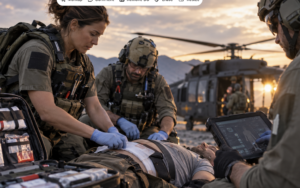
Emergency response has always depended on speed, preparation, communication, and access to the right equipment at the right moment. What is changing rapidly is the role information technology now plays in connecting those elements. Modern emergency medicine is increasingly supported by digital communications, connected devices, location services, data platforms, mobile networks, and smarter logistics systems that can help responders make critical decisions faster.
The transformation extends well beyond hospitals and ambulances. Law enforcement agencies, emergency medical services, industrial safety teams, security professionals, event operators, military personnel, disaster-response organizations, schools, businesses, and public venues increasingly operate in environments where medical preparedness and information technology overlap.
According to Wikipedia’s overview of information technology, IT encompasses computers, telecommunications systems, software, networks, and technologies used to create, process, store, retrieve, and transmit information. Those capabilities are now deeply connected to emergency response.
A medical kit may still contain familiar physical supplies, but the systems surrounding that kit are becoming considerably more advanced. Inventory management software can monitor supplies. Mobile networks can connect responders with command centers. GPS can improve location awareness. Digital platforms can distribute emergency procedures. Broadband networks can transmit photographs, video, patient information, and operational updates.
The result is a new era in which emergency medical equipment and information technology increasingly work together.
Connected Communications Are Changing the First Minutes of an Emergency
The earliest moments of a serious medical emergency can determine how effectively responders coordinate care. Traditionally, information might have moved through radio calls, dispatchers, handwritten notes, or verbal updates between personnel. These methods remain important, but modern IT infrastructure adds additional communication channels.
The National Institute of Standards and Technology Public Safety Communications Program focuses specifically on advancing communications technologies used by first responders. NIST notes that communication between personnel at an emergency scene and incident command remains a critical part of successful emergency response.
Modern public-safety technology can combine traditional land-mobile radio with broadband data networks, smartphones, tablets, mapping systems, cameras, and other connected devices.
For emergency medical personnel, these capabilities can mean receiving more information before reaching the patient. Dispatch centers may be able to provide updated location details, photographs, video, or information gathered from other responders already at the scene.
Faster information flow does not replace medical training. It helps trained personnel reach the scene with a clearer operational picture and coordinate their actions more efficiently.
5G and Public-Safety Networks Are Expanding Field Connectivity
Mobile broadband represents one of the most significant IT developments affecting emergency response. The ability to transmit large amounts of data from the field gives responders options that were difficult or impossible with voice communication alone.
The First Responder Network Authority’s emergency communications resources describe how public-safety broadband can support the transmission of video, photographs, text messages, personnel locations, and other data between emergency communications centers and responders in the field.
This can be especially valuable during complex incidents involving multiple teams.
A responding unit could potentially receive building information before arrival. Emergency personnel could transmit images from an incident scene. Command staff could track equipment and personnel locations. Dispatchers could distribute updated information without relying entirely on voice traffic.
New developments may expand these capabilities even further.
In September 2026, NIST reported research involving 5G sidelink technology for public-safety communications. This approach is designed to allow compatible devices to communicate directly in certain situations, including environments where normal network infrastructure has been disrupted.
That capability could become increasingly important during hurricanes, wildfires, earthquakes, large accidents, and other emergencies in which cellular infrastructure becomes unavailable or overloaded.
Location Technology Can Reduce Time Lost During Critical Incidents
Finding the correct patient or incident location sounds simple until an emergency occurs inside a large building, industrial complex, stadium, warehouse, university campus, convention center, or entertainment venue.
GPS technology has transformed outdoor navigation, but emergency-response technology is moving toward more detailed location awareness.
Indoor positioning, building mapping, geolocation systems, connected sensors, and responder-tracking technology can help emergency teams identify where personnel, patients, and critical resources are located.
In a large venue, knowing that an incident occurred somewhere inside the building provides only limited information. Knowing the floor, section, entrance, access route, and approximate location of the patient can significantly improve coordination.
Location technology also has implications for medical equipment placement.
Organizations can maintain digital maps showing where emergency supplies, automated external defibrillators, fire equipment, and other critical resources are located. When combined with mobile applications or emergency-management platforms, personnel may be able to identify the closest available equipment immediately.
Digital Inventory Systems Are Improving Medical Readiness
One of the less visible applications of IT involves inventory management.
Medical response equipment is useful only when its contents are present, accessible, and within appropriate service or expiration periods. Organizations managing multiple emergency kits may have hundreds or thousands of individual medical items distributed across vehicles, facilities, departments, or geographic locations.
Manual inspection remains important, but digital inventory systems can make the process easier to manage.
Barcodes, QR codes, RFID technology, cloud databases, and asset-management platforms can help organizations track individual kits and their contents. Software may record inspection dates, replenishment needs, equipment assignments, expiration information, and deployment history.
For a company operating numerous facilities, this creates a centralized view of readiness.
Instead of relying solely on individual paper checklists stored at each location, safety managers can maintain digital records that identify which equipment has been inspected and which supplies require attention.
This type of IT integration illustrates how emergency preparedness increasingly extends beyond the physical products stored inside a medical bag.
Interoperability Is Becoming Essential for Emergency Technology
Technology creates tremendous advantages only when systems can communicate effectively.
An emergency involving police officers, firefighters, EMS personnel, hospital teams, security personnel, and emergency managers may involve several agencies using different hardware and software systems.
That makes interoperability a major IT issue.
The Cybersecurity and Infrastructure Security Agency’s National Emergency Communications Plan emphasizes interoperable communications and the ability of emergency-response organizations to securely share information across technologies and jurisdictions.
Interoperability allows information to move between organizations rather than remaining isolated inside separate systems.
This matters during large emergencies because incidents rarely respect organizational boundaries. A serious event at a concert venue, manufacturing facility, transportation hub, school, sports stadium, or public gathering may quickly involve private security, local EMS, police, firefighters, hospitals, emergency managers, and other organizations.
A more connected emergency-response ecosystem makes it possible for those groups to coordinate around shared information.
Mobile Devices Are Becoming Emergency Information Platforms
Smartphones and tablets have become standard computing tools, and their role in emergency response continues to expand.
A ruggedized mobile device can potentially provide mapping, communications, reference materials, photographs, video, checklists, incident reports, weather information, building plans, and access to secure operational platforms.
This changes how responders interact with information in the field.
Printed reference material remains valuable because it functions without electricity or network access. Digital systems, however, can provide large amounts of current information in a portable format.
Organizations can also update digital procedures centrally. When protocols, contact information, facility maps, or operating procedures change, revised information can be distributed more efficiently across a workforce.
Research from the NIST Voices of First Responders project has examined how police, fire, EMS, and 911 professionals use communications technologies and what improvements they want from future systems. The research highlights an important lesson for technology developers. Emergency technology must function in the environments where responders actually work.
A feature that performs beautifully in an office can become frustrating when used outdoors, in poor weather, while wearing gloves, under extreme time pressure, or in a chaotic incident scene.
Effective emergency IT therefore requires more than powerful software. It requires usability.
Data Can Strengthen Emergency Preparedness Before an Incident Occurs
Some of the most valuable emergency-response technology operates long before an emergency happens.
Organizations generate information every time equipment is inspected, deployed, replenished, relocated, or used. Over time, this information can reveal patterns.
A venue may discover that certain types of medical supplies are used more frequently during specific events. A company may identify facilities with unusually high emergency-response activity. An emergency-management organization may recognize areas where equipment should be repositioned.
Data analytics can transform isolated incidents into information that supports future planning.
This is one reason IT and emergency management are becoming increasingly connected. Emergency preparedness is no longer limited to purchasing equipment and placing it in a cabinet or vehicle. Organizations can use digital systems to understand how equipment is distributed, how frequently it is used, and where preparedness gaps may exist.
The Department of Homeland Security Science and Technology Directorate has highlighted a range of technologies intended to strengthen first-responder capabilities. These initiatives reflect the expanding relationship between technical innovation, emergency management, public safety, and real-world field operations.
Cybersecurity Is Now Part of Emergency Readiness
Greater connectivity also creates new responsibilities.
A traditional medical bag presents little cybersecurity risk. A connected emergency-response ecosystem can involve networks, cloud platforms, smartphones, databases, location information, cameras, sensors, and communications systems.
Those technologies must be protected.
An unavailable system during a crisis can create operational problems. Unauthorized access to sensitive information can create privacy and security concerns. Compromised communications infrastructure can interfere with coordination.
Cybersecurity therefore becomes part of emergency preparedness when organizations depend on digital systems.
Resilient systems should account for outages, network congestion, equipment failure, cyber incidents, and situations in which internet connectivity disappears completely.
The best technology strategy maintains redundancy. Digital systems should strengthen emergency response without creating a single point of failure.
Artificial Intelligence Could Become Another Layer of Emergency Technology
Artificial intelligence is beginning to influence nearly every area of information technology, and emergency management is likely to see continued experimentation with AI-supported tools.
Potential applications include analyzing incoming incident data, prioritizing alerts, identifying patterns, translating communications, organizing reports, assisting with resource allocation, monitoring equipment inventories, and helping command personnel process large volumes of operational information.
AI systems could also help analyze historical emergency data to identify preparedness trends.
Human oversight remains essential.
Emergency response involves unpredictable environments, rapidly changing conditions, incomplete information, and decisions with serious consequences. AI is better viewed as another information-processing tool rather than a replacement for trained responders.
The greatest potential may come from using technology to reduce administrative workload and organize information so experienced professionals can concentrate on the decisions that require human judgment.
The Future Is a Connected Emergency-Response Ecosystem
The larger technology story is not about turning every piece of medical equipment into a computerized device. It is about connecting people, information, equipment, and communications systems more effectively.
Physical medical supplies remain essential. Reliable communications remain essential. Training remains essential. Human judgment remains essential.
IT adds another layer that can connect those resources.
A future emergency-response environment may include broadband communications, direct device-to-device connectivity, indoor positioning, wearable technology, digital inventory management, cloud-based incident platforms, real-time mapping, AI-assisted information processing, and secure information sharing between agencies.
The infrastructure supporting emergency response is becoming increasingly digital, and that trend creates opportunities for technology companies, public-safety agencies, medical suppliers, IT departments, emergency managers, and security organizations to work more closely together.
Conclusion
Information technology is changing emergency response by improving the speed at which information moves, the accuracy of location data, the visibility of Tactical Trauma Kits, and the ability of separate organizations to communicate during complex incidents.
The most important development may be the connection between technologies that once operated independently.
Communications networks can connect dispatchers with responders. Location systems can connect personnel with incident sites. Inventory platforms can connect organizations with equipment status. Broadband networks can connect field personnel with photographs, video, maps, and operational data. Analytics can connect past incidents with future preparedness.
That integration represents the direction emergency-response technology is moving.
Medical readiness will continue to depend on properly equipped personnel, quality supplies, practical training, and established procedures. IT can strengthen each of those elements by delivering information faster and helping organizations coordinate resources more effectively.
As communications networks, mobile computing, location services, data platforms, and intelligent software continue to advance, the technology surrounding emergency medical response will become more connected, more resilient, and increasingly capable of supporting critical decisions when every second matters. ⚕️